
Last updated September 25, 2026
Free written scope consultation - allowances, timeline, and change-order rules on paper before a single trade is scheduled







 Before
 After
After Before
 After
After Before
 After
AfterKitchen Remodeling Maintenance Checklist for Chula Vista Homeowners
Cabinet hinges in coastal San Diego kitchens show measurable salt corrosion within 24 months if the wrong finish was specified. Most homeowners don’t find out until the door sags and the warranty has lapsed. In Chula Vista, where the marine layer rolls in from San Diego Bay and summer humidity can swing from 45% to 85% in a single day, a kitchen remodel’s real test begins after the last contractor leaves. We’ve delivered over 4,000 Kitchen Remodeling services since 2007, and the ones that look best at year five share one trait: the owner followed a maintenance calendar in the first 18 months. This guide gives you that exact schedule, tuned to Chula Vista’s climate, with the specific measurements and product names that keep a $40,000 investment from failing at grout lines, cabinet hinges, and exhaust seals.
Quick Answer
A kitchen remodeling maintenance checklist for Chula Vista homeowners covers monthly checks of caulk seams and exhaust airflow, quarterly hinge and track cleaning, semi-annual sealant reapplication on natural stone, and annual verification of cabinet hardware corrosion. The first 18 months after remodel completion are critical because coastal humidity, salt air, and temperature swings accelerate material degradation that inland kitchens experience more slowly. Follow the month-by-month schedule below, or see our Seasonal Construction Care for Chula Vista: Year-Round Homeowner’s Guide, to catch problems before they void your warranty or require costly rework.
Table of Contents
- Month-by-Month Maintenance Calendar: First Year Post-Remodel
- Grout and Caulk: The 2-Millimeter Rule for Water Intrusion
- Exhaust Fan CFM Verification: Is Your Hood Actually Working?
- Cabinet Hardware Finishes That Survive Chula Vista’s Marine Layer
- Countertop Care by Material: Sealants, Products, and Intervals
- Common Mistakes to Avoid
- When to Call a Professional
- Frequently Asked Questions
 Before
 After
AfterMonth-by-Month Maintenance Calendar: First Year Post-Remodel
The first year after a kitchen remodel is when materials settle, sealants cure fully, and installation defects reveal themselves. Chula Vista’s climate makes this period especially consequential. The marine layer brings salt-laden moisture that condenses on cooler surfaces, and the inland heat spikes of August and September cause rapid expansion and contraction. Here’s what to check and when.
Months 1-3: Settlement and Initial Curing
During the first 90 days, your cabinets, countertops, and tile are adjusting to the home’s normal humidity and use patterns. This is when grout cracks from structural movement and caulk separation from improper substrate prep show up.
- Week 2: Inspect all caulk lines at the backsplash-to-countertop seam, sink deck, and window surrounds. Look for gaps wider than 2mm or any section where the caulk has pulled away from one side. Use a 5-in-1 painter’s tool to probe gently; if the caulk separates, it needs removal and reapplication with a mold-resistant silicone like GE Advanced Silicone 2 Kitchen & Bath.
- Month 1: Check cabinet door alignment with a 24-inch level. Doors should sit within 1/16 inch of level. Hinges may need quarter-turn adjustment as wood acclimates. Use a #2 Phillips screwdriver on Blum or Salice hinges; avoid power drivers that strip the adjustment screws.
- Month 2: Test all drawer slides under full load. Load plates or cookware to rated capacity (typically 75-100 lbs for full-extension soft-close slides). Listen for grinding or popping that indicates misalignment.
- Month 3: Run your exhaust fan for 30 minutes during peak cooking and hold a tissue at the hood intake. It should pull flat against the filter. If it flutters or falls, note the CFM check procedure in the section below.
Months 4-6: First Seasonal Cycle
Chula Vista’s spring brings moderate humidity, but early summer can push temperatures above 85°F with humidity dropping sharply. This expansion-contraction cycle tests every adhesive bond.
- Quarterly hinge cleaning: Remove cabinet doors if possible, or work with them open. Wipe hinge cups and arms with a microfiber cloth dampened in denatured alcohol to remove cooking grease and salt residue. Apply a thin film of white lithium grease to pivot points. Do not use WD-40; it attracts dust and gums up in coastal air.
- Sink cabinet floor inspection: Look for water staining or particleboard swelling. The area under the sink is the most common failure point in Chula Vista kitchens because the P-trap vibrates loose and the marine layer keeps evaporation slow. A battery-powered water alarm like the Govee WiFi Water Sensor costs under $20 and catches leaks before they destroy a cabinet base.
- Tile grout permeability test: Sprinkle water on grout lines. If it beads, the sealer is intact. If it darkens and absorbs, reseal with Aqua Mix Sealer’s Choice Gold or similar penetrating sealer rated for 5-year protection.
Months 7-12: Full Climate Exposure
By late summer, your kitchen has seen Chula Vista’s full range. The August heat and September Santa Ana conditions stress materials differently than the marine layer months.
- Month 7 (August): Check for countertop seam separation, especially on quartz and solid-surface materials. Heat expansion can open seams at the epoxy fill. A gap wider than a credit card edge (approximately 0.8mm) needs professional repair; smaller gaps can be filled with color-matched epoxy from the manufacturer.
- Month 9 (October): As humidity returns, inspect for mold at all caulk joints. Chula Vista’s fall marine layer is persistent; any caulk that failed in spring will now harbor mildew. Remove and replace with fresh mold-resistant silicone.
- Month 12: Full-system review. Document with photos. Check every item from months 1-9, plus: verify that all cabinet hardware operates smoothly, test GFCI outlets near the sink for proper trip function, and confirm that range hood filters are clean (soak in degreaser, not dishwasher, if baffle-style; replace if mesh is corroded).
Months 13-18: The Critical Extension
Most contractor warranties expire at 12 months. The 13-18 month window is when latent defects appear and you’re now self-insuring. In Chula Vista, this is also when salt corrosion on non-marine-grade hardware becomes visible.
At month 15, do a focused check of all exterior-facing hardware: window latches, any cabinet pulls near open windows, and ventilation grilles. Look for reddish-brown staining on “stainless” hardware that is actually 201-grade or plated zinc. This is your last chance to claim premature failure before the warranty expires on most cabinet and fixture lines.
Grout and Caulk: The 2-Millimeter Rule for Water Intrusion
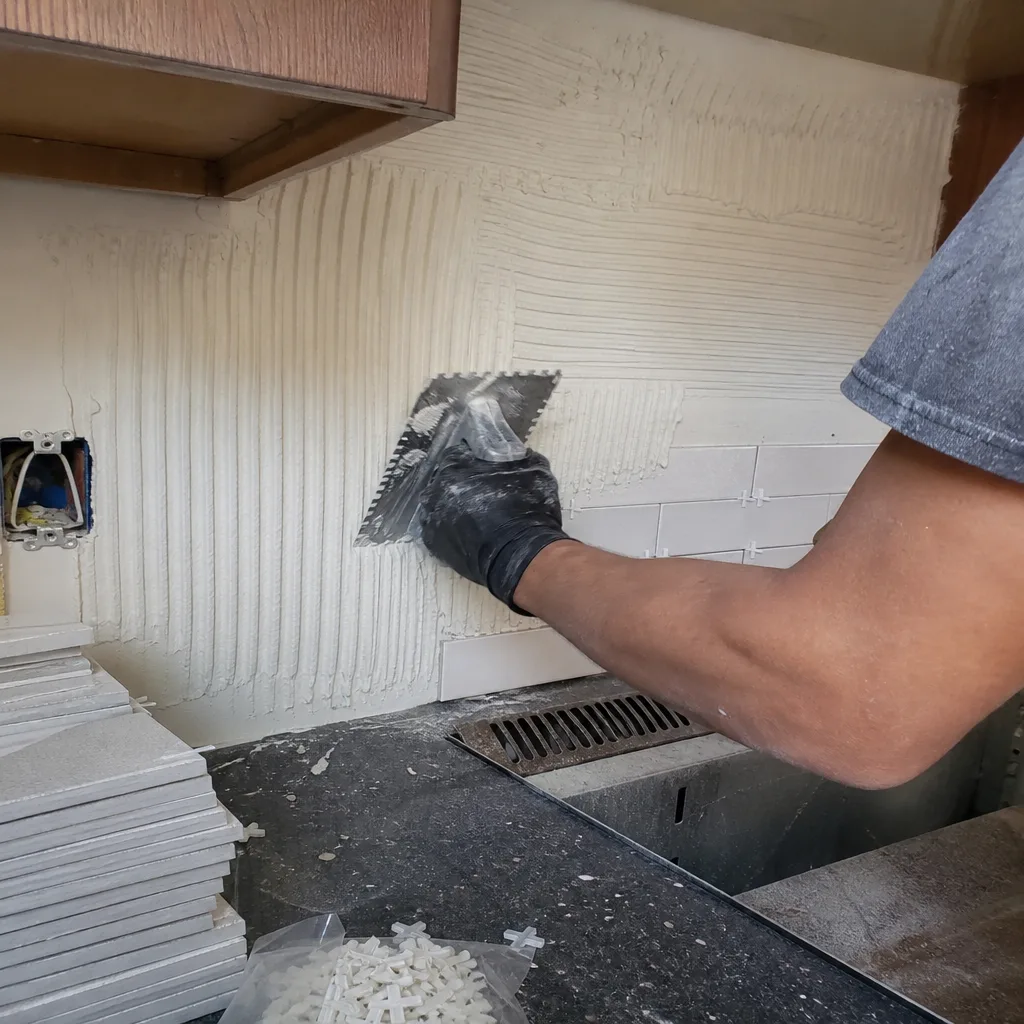
The tile-to-countertop seam is the most water-exposed joint in any kitchen. In Chula Vista, where outdoor grilling is year-round and kitchen windows stay open for ventilation, this seam sees more moisture cycling than inland climates produce.
The 2-millimeter rule: Any gap or crack in the caulk bead that measures 2mm or wider at any point requires immediate removal and resealing. At 2mm, capillary action draws water into the substrate faster than evaporation removes it in humid coastal conditions. Below 2mm, surface tension keeps most water on the surface where it evaporates.
To measure accurately, use a plastic feeler gauge set (available at any hardware store for under $10) or a digital caliper if you own one. Don’t guess. A gap that looks “small” to the eye is often 3-4mm when measured.
What Normal Settling Looks Like vs. Failure
| Condition | Appearance | Action |
|---|---|---|
| Normal curing shrinkage | Uniform slight concavity in caulk bead, no separation from either side | Monitor; no action needed |
| Adhesive failure | Caulk separates from one side, visible gap, often triangular | Remove and reapply immediately |
| Cohesive failure | Caulk splits down the middle, both sides still bonded | Remove and reapply; indicates wrong product or movement exceeded spec |
| Grout crack at plane change | Hairline crack where backsplash meets counter | Remove grout, install backer rod, caulk over with color-matched silicone |
For Chula Vista kitchens, we specify 100% silicone caulk with moldicide, never acrylic latex “kitchen and bath” caulk. The acrylic products fail within 18 months in coastal humidity. GE Advanced Silicone 2 and DAP Kwik Seal Ultra are the two products we see hold up; both remain flexible below 2mm movement and resist UV degradation from south-facing windows common in Chula Vista’s Eastlake and Otay Ranch developments.
Grout sealer reapplication interval in Chula Vista: every 12 months for cementitious grout in splash zones, every 24 months for epoxy grout or dry areas. Use a penetrating sealer, not a topical coating. Topical sealers (the kind that form a plastic film) peel in humid conditions and trap moisture underneath.
Exhaust Fan CFM Verification: Is Your Hood Actually Working?
A range hood rated at 600 CFM (cubic feet per minute) is not moving 600 CFM if the duct run is too long, too small in diameter, or obstructed. In Chula Vista, where many homes built 1985-2005 have 4-inch dryer-duct material repurposed for kitchen vents, the actual airflow can be less than half the rated capacity. The result is grease accumulation on cabinets, premature finish failure, and persistent humidity that breeds mold.
How to Test Your Hood’s Actual CFM
You don’t need a professional anemometer, though one helps. Here’s a three-step verification any homeowner can perform:
- Calculate your target CFM. Kitchen code (IRC M1507.4) calls for 100 CFM minimum or 5 air changes per hour, whichever is greater. For a 10x12x8-foot kitchen, that’s 960 cubic feet; at 5 ACH, you need 80 CFM minimum. For gas cooking, add 100 CFM per 10,000 BTU of burner output. A typical four-burner gas range at 40,000 BTU needs 400 CFM minimum; with a 12-inch grill adder, 600 CFM is the practical target.
- Measure actual airflow with the tissue test. Turn the hood to high. Hold a single sheet of toilet paper or a lightweight tissue against the filter from below. It should pull flat and hold. If it flutters or falls away, airflow is inadequate. For a numeric estimate, a digital anemometer ($25-$40) held at the filter face gives feet-per-minute; multiply by filter area in square feet for approximate CFM. A 30-inch hood with two 10×12-inch filters (1.67 sq ft total) needs 360 FPM average to deliver 600 CFM.
- Inspect the duct run. Go to the exterior termination. With the hood running, you should feel strong airflow. Common blockages in Chula Vista homes include: bird nests in terminations (the marine layer attracts insects that attract birds), lint-like grease buildup in corrugated flexible ducting, and dampers stuck closed from salt corrosion. The exterior damper should open fully and flap freely when the hood runs; if it barely moves, there’s a restriction.
What blockage looks like in practice: Grease accumulation on the upper cabinet faces, condensation on windows during cooking, and a persistent cooking odor hours after meal preparation. These are not “just how kitchens are” - they are symptoms of failed ventilation that will degrade your remodel investment.
If your duct run exceeds 20 feet equivalent (count 5 feet for each 90-degree elbow), you need rigid metal ducting at minimum 6-inch diameter, preferably 8-inch, even if the hood connection is 6-inch. Reducers choke airflow. In Chula Vista’s older neighborhoods like Castle Park and Hilltop, we’ve found hoods connected to 4-inch flex duct running 25 feet through attics - a configuration that delivers under 150 CFM regardless of the hood’s rating.
Cabinet Hardware Finishes That Survive Chula Vista’s Marine Layer
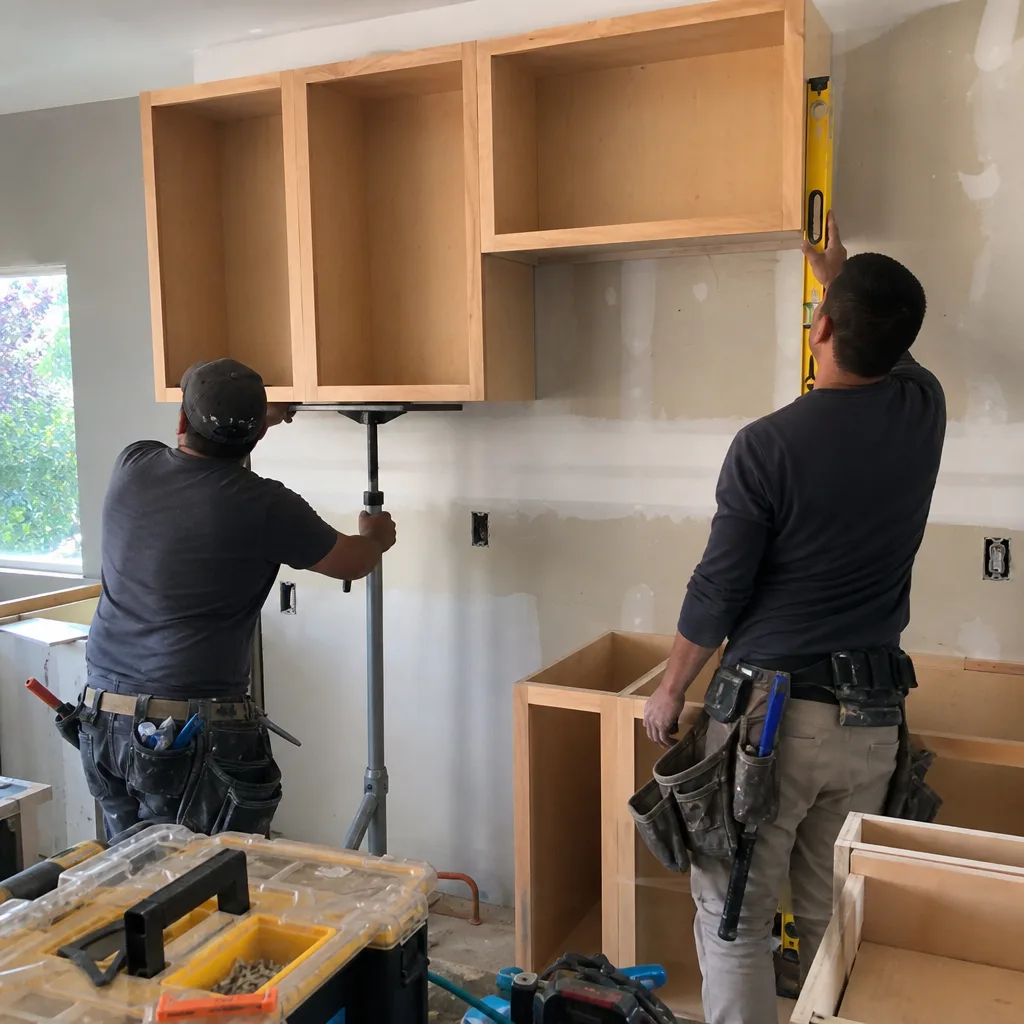
Not all “stainless steel” is equal. The hardware finish you chose from a catalog photograph will look different after 36 months in Chula Vista’s salt air. Here’s what holds up and what doesn’t, based on our field observations across 4,000-plus projects.
Finish Durability Rankings for Coastal Conditions
| Finish | Base Metal | Expected Life in Chula Vista | Notes |
|---|---|---|---|
| 316 marine-grade stainless | 316 SS | 15+ years | Best for homes within 2 miles of the bay; higher initial cost, no coating to fail |
| 304 stainless, brushed | 304 SS | 8-12 years | Standard for quality cabinets; occasional surface staining treatable with Bar Keepers Friend |
| Oil-rubbed bronze, solid brass base | Brass with living finish | 10-15 years (patina changes) | Color evolves but metal does not fail; acceptable if you want the aged look |
| Brushed nickel, PVD coating | Zinc or brass | 5-8 years | PVD coating eventually micro-cracks; corrosion starts at edges |
| “Stainless look” plated zinc | Zinc die-cast | 2-4 years | Reddish corrosion visible at 18 months; avoid entirely |
| Polished chrome over zinc | Zinc die-cast | 3-5 years | Pitting starts at surface imperfections; high maintenance |
The marine layer in Chula Vista extends farther inland than most residents realize. Homes in Eastlake, Rolling Hills Ranch, and even parts of Otay Ranch experience salt deposition during night and early morning hours when the layer moves east. If your kitchen windows face west or southwest, hardware on that wall sees accelerated exposure.
What to do at month 12: Inspect all pulls and hinges with a 10x loupe or strong reading glasses. Look for pitting, discoloration at edges, or a cloudy film that doesn’t wipe clean with alcohol. If you see these signs and your hardware is under warranty, document with photos and contact your cabinet supplier. The 365-Day Done Right Promise from Rowan Construction Group Chula Vista home covers premature hardware failure if we specified the product; most cabinet manufacturers offer 5-year finish warranties on qualifying grades.
For replacement hardware in year 3-5, we specify 316 stainless or solid brass with living finish for Chula Vista clients. The upfront cost difference is 30-50%, but the replacement labor (removing doors, filling old holes, drilling new ones, touch-painting) typically costs more than the hardware itself.
Countertop Care by Material: Sealants, Products, and Intervals
Countertop maintenance is where generic advice fails and specific product names matter. The sealant that works for Arizona granite will not perform in Chula Vista’s humidity. Here are the actual products and schedules we specify in our written scope documents.
Quartz (Engineered Stone)
Quartz is non-porous and does not require sealing - this is its primary selling point. However, the resin binder (typically 7-10% of the material) can degrade with prolonged UV exposure and can stain from aggressive chemicals.
- Clean with: Simple Green Pro HD or equivalent pH-neutral cleaner. Avoid Bar Keepers Friend, which is slightly acidic and will etch the resin surface over time.
- Prevent: Thermal shock from hot pans directly on surface. Use trivets; the resin can craze (develop microcracks) from rapid temperature change.
- Chula Vista specific: South-facing kitchens with large windows get significant UV through glass. We’ve seen Cambria and Caesarstone surfaces yellow slightly at window-adjacent edges after 5-7 years. Consider UV-filtering window film if your kitchen faces south or west.
- Interval: No sealing required. Annual inspection for surface damage.
Granite and Other Natural Stone
Granite is porous and must be sealed. The interval depends on the stone’s density and your kitchen’s use pattern.
- Sealer product: Aqua Mix Sealer’s Choice Gold or StoneTech Bulletproof. Both are fluoropolymer-based penetrating sealers that last 3-5 years under normal use. In Chula Vista’s humidity, we recommend 2-year reapplication for splash zones and 3-year for dry areas.
- Test for need: Water drop test. Place a quarter-sized puddle on the surface. If it absorbs and darkens the stone within 10 minutes, reseal. If it beads for 30 minutes, the sealer is intact.
- Clean with: pH-neutral stone cleaner. Never vinegar, lemon, or bleach; these etch or degrade the sealer.
- Oil stain removal: Apply a poultice of baking soda and acetone, cover with plastic wrap, let dry 24 hours. For stubborn stains, commercial poultice products like Aqua Mix Poultice Stain Remover are more effective.
Butcher Block (Wood)
Butcher block requires the most active maintenance but rewards it with repairability. In Chula Vista’s variable humidity, wood movement is the primary concern.
- Monthly: Inspect for cracks or separation at glue joints. Humidity swings cause expansion and contraction; a crack wider than 1mm needs filling with food-safe epoxy or wood filler, then re-oiling.
- Quarterly: Re-oil with mineral oil or Howard Butcher Block Conditioner (which adds beeswax for water resistance). Apply liberally, let sit 20 minutes, wipe excess. In dry months (Santa Ana conditions), oil monthly.
- Annual: Light sanding with 220-grit to remove stains and cuts, then re-oil. Deeper damage can be sanded to bare wood and refinished - something no other countertop material allows.
- Chula Vista specific: Keep butcher block away from direct window exposure. The combination of UV and humidity cycling causes uneven expansion and “cupping” (edge curling). We’ve replaced several island tops in Chula Vista homes where the block was installed under a skylight without UV protection.
- Clean with: Soapy water or ammonia-based cleaner. Avoid window cleaner with ammonia on dark colors; it can leave a film.
- Remove scratches: Use a Scotch-Brite pad in the direction of the satin finish, progressing from maroon (coarse) to gray (fine) if needed. Deep scratches require orbital sander with 120- then 220-grit, followed by polishing compound.
- Interval: As-needed scratch removal; no sealing required.
- Using a Magic Eraser on cabinets. The melamine foam is abrasive and removes the conversion varnish or catalyzed lacquer finish on most cabinet doors. In Chula Vista’s light, the dull spot becomes visible within weeks. Use a soft cloth with mild dish soap instead.
- Ignoring the dishwasher air gap. California plumbing code requires an air gap at the sink rim, not just a high loop. If your remodel included a new dishwasher, verify the air gap is installed and clear. Backflow into the dishwasher from a clogged gap floods the cabinet base - the most common insurance claim we see in Chula Vista kitchens at month 6-12.
- Re-caulking over old caulk. New silicone will not bond to cured silicone. The old bead must be fully removed with a razor scraper and the joint cleaned with mineral spirits. In Chula Vista’s humidity, a partial bond traps water and accelerates substrate rot.
- Running the exhaust fan only during cooking. The fan should run 15 minutes after cooking ends to clear residual moisture and particulates. In Chula Vista’s humid climate, this post-cook run prevents grease deposition on cabinet faces and reduces mold risk at caulk joints.
- Using generic “stainless steel cleaner” on appliances and hardware. Many contain mineral oil that attracts dust and salt particles. For hardware, use a microfiber cloth with warm water only, dried immediately. For appliances, we recommend Weiman Stainless Steel Cleaner for fingerprint resistance; apply with the grain, buff with dry cloth.
- Neglecting the garbage disposal mounting assembly. The sink flange and mounting ring are dissimilar metals that galvanically corrode in salt air. Annual removal, cleaning, and reapplication of plumber’s putty prevents the leaks that destroy cabinet bases. This is a 30-minute task most homeowners never do.
- Waiting for warranty expiration to report issues. Most cabinet, countertop, and appliance warranties require prompt reporting of defects. A hinge that squeaks at month 8 may be corrosion starting; report it then, not at month 14 when the warranty has lapsed.
Solid Surface (Corian, Wilsonart, etc.)
Solid surface is repairable but softer than stone. Scratches accumulate and are removed with abrasive pads in progressive grits.
Common Mistakes to Avoid
When to Call a Professional
Some maintenance tasks require tools or expertise beyond typical homeowner capacity. Call a licensed contractor if you find: countertop seam separation wider than 0.8mm, water staining in cabinet bases that indicates active plumbing failure, electrical issues at GFCI outlets (tripping, buzzing, or failure to reset), or exhaust ductwork blockage that cannot be cleared from the exterior termination. Structural movement cracks in tile or drywall, especially if they reappear after repair, may indicate foundation issues common in Chula Vista’s expansive clay soils - particularly in older neighborhoods like Castle Park where fill practices varied. For deeper context, see The Complete Guide to Construction in Chula Vista.
Rowan Construction Group Chula Vista offers free estimates in Chula Vista - call (619) 536-0571. We provide a written price before any work starts, every time, under Clause 1 of The Haven Standard. If you have a competitor’s estimate, we’ll review it line by line at no charge through our Free Second Opinion program.
Frequently Asked Questions
Annual maintenance supplies for a typical Chula Vista kitchen run $80-$150: caulk ($12), grout sealer ($35), hinge lubricant ($8), countertop cleaner and conditioner ($25), and replacement water alarm batteries ($10). Professional re-caulking or grout sealing services range $200-$400 for a standard kitchen. Call (619) 536-0571 for an exact quote - estimates are free.
No. At Rowan Construction Group Chula Vista, the written price before any work starts is Clause 1 of The Haven Standard. No change proceeds without a signed change order, which is the discipline that has kept our projects within a few percent of the agreed cost across 4,000-plus jobs since 2007.
Every 2-3 years for splash zones and 3 years for dry areas, which is more frequent than the 5-year interval recommended for inland climates. Chula Vista’s marine layer and humidity keep stone closer to saturation, reducing sealer longevity. Test annually with the water drop method; reseal when absorption occurs within 10 minutes.
Pure maintenance (re-caulking, cleaning, hardware adjustment) does not require permits. Repairs involving plumbing, electrical, or structural modification do require permits under Chula Vista municipal code. Rowan Construction Group pulls all required permits and schedules inspections as part of any repair scope that crosses into regulated work - documented in the written price before work starts.
316 marine-grade stainless steel for homes within 2 miles of San Diego Bay, including neighborhoods like Egger Highlands and the western edge of Castle Park. The molybdenum content in 316 resists salt corrosion that damages standard 304 stainless in 3-5 years. For inland Chula Vista homes in Eastlake or Otay Ranch, 304 stainless or solid brass with living finish perform adequately.
Perform the tissue test: with the hood on high, hold a tissue at the filter. It should pull flat and hold. Check the exterior damper - it should open fully and show strong airflow. If either test fails, measure duct diameter and length; 4-inch flex duct over 20 feet is a common Chula Vista defect that cannot deliver rated CFM regardless of hood power. Call (619) 536-0571 for a free assessment if you suspect inadequate ventilation.
A quality kitchen remodel with proper maintenance lasts 20-30 years before major component replacement. However, the first 18 months determine long-term outcomes: sealants cure and settle, installation defects appear, and material acclimation completes. The maintenance schedule in this guide, followed closely in year one, separates kitchens that look new at year ten from those showing wear at year three. In Chula Vista’s climate, the difference is especially pronounced due to salt air and humidity cycling.
The Bottom Line
A kitchen remodel in Chula Vista is a significant investment that doesn’t end when the contractors leave. The first 18 months require active maintenance: monthly caulk and exhaust checks, quarterly hinge cleaning and drawer testing, semi-annual sealant verification, and annual full-system documentation. The specific products matter - 316 stainless hardware, 100% silicone caulk, fluoropolymer stone sealers - and the schedule is tighter than inland climates demand. Follow this checklist and your kitchen will look and function as intended at year five and beyond. Explore more guides & resources for keeping your home in top condition. Skip it, and the marine layer will find the shortcuts.
For homeowners considering a new kitchen remodel or addressing maintenance issues beyond DIY scope, Kitchen Remodeling in Chula Vista from Rowan Construction Group includes a written maintenance schedule in every project scope. We also offer Bathroom Remodeling in Chula Vista and Roofing in Chula Vista under the same documented, price-first approach.
Call (619) 536-0571 to schedule your free estimate. Every project receives a flat written price and written scope before work begins, with a documented photo record on every visit and the 365-Day Done Right Promise printed on every agreement.
Written by Grant Rowan, Owner at Rowan Construction Group Chula Vista, serving Chula Vista since 2007.