
Free written scope consultation - allowances, timeline, and change-order rules on paper before a single trade is scheduled

 Before
 After
After Before
 After
After Before
 After
AfterHow Much Does Backsplash Installation Cost in Chula Vista?
Backsplash installation in Chula Vista, CA typically costs between $800 and $2,500 for a standard kitchen or bathroom project, with most homeowners landing somewhere in the $1,100-$1,700 range depending on the tile material and linear footage involved. Labor runs $35-$65 per square foot in the Chula Vista market, and material costs vary widely - from $2 per square foot for ceramic subway tile to $18 or more per square foot for handmade Zellige or natural stone. A written price before any work starts is the only way to know exactly what you’re paying, and that’s the first thing Backsplash Installation in Chula Vista by Rowan Construction Group puts in your hands.
Backsplash Installation Cost Breakdown (2026)
These ranges reflect real project data from the Chula Vista market in 2026. They account for local labor rates in San Diego County, typical material availability at regional suppliers, and the substrate conditions we commonly encounter in homes built across Chula Vista’s varied housing stock - from the 1970s tract neighborhoods near Hilltop Drive to the newer construction in Eastlake and Otay Ranch.
| Project Type | Typical Cost Range | What’s Included |
|---|---|---|
| Ceramic or Porcelain Subway Tile (standard kitchen, 20-30 sq ft) | $800-$1,300 | Tile, thinset, grout, basic installation |
| Glass or Mosaic Tile (kitchen feature wall) | $1,100-$1,800 | Higher-cost tile, mesh-back setting, grout |
| Natural Stone (travertine, slate, marble) | $1,400-$2,200 | Tile, penetrating sealer, thinset, grout |
| Zellige or Handmade Artisan Tile | $1,700-$2,500 | Premium tile, hand-setting labor, irregular grouting |
| Peel-and-Stick / Adhesive Tile (DIY-grade, not recommended for full kitchens) | $300-$700 | Materials only; not a service Rowan provides |
| Backsplash Removal (existing tile demo, prep, disposal) | $150-$400 added cost | Demo labor, haul-away, substrate assessment |
| Substrate Repair or Backer Board Installation | $200-$500 added cost | Cement board, screws, waterproofing membrane where needed |
| Full Kitchen Backsplash (countertop to upper cabinets, 40-60 sq ft) | $1,200-$2,500 | All tile, setting materials, grout, caulk at transitions |
| Bathroom Backsplash (vanity area, 8-15 sq ft) | $800-$1,400 | Tile, waterproof membrane, grout |
The single biggest swing in any backsplash quote is material cost. Ceramic subway tile from a national supplier like Daltile runs $2-$5 per square foot. Handmade Moroccan Zellige, which has become popular in the coastal San Diego market including Chula Vista’s newer Eastlake Village homes, runs $14-$22 per square foot for the tile alone before a single trowel is picked up. The second-biggest variable is substrate condition. Many Chula Vista homes built between 1985 and 2005 have drywall behind the existing backsplash, not cement board. When we remove old tile and find drywall that’s been compromised by years of steam and moisture, backer board installation isn’t optional – it’s what keeps the new tile from failing in 18 months.
Labor rates in Chula Vista and the broader South Bay area of San Diego County have risen approximately 12-15% since 2023, driven partly by demand in the Otay Ranch and Millenia master-planned communities where kitchen upgrades are common during home sales. A straightforward subway tile job runs $35-$45 per square foot in labor. Intricate patterns – herringbone, Versailles, stacked vertical – add $8-$15 per square foot in labor because the cuts multiply and the layout time increases significantly.
What Affects Backsplash Installation Pricing in Chula Vista
- Tile material and format: The gap between a $2/sq ft ceramic tile and a $20/sq ft handmade artisan tile is real and it compounds fast. A 40-square-foot kitchen backsplash costs $80 in ceramic tile or $800 in Zellige – before any labor is quoted. Format matters too: large-format tiles (12×24 or bigger) require more precise substrate prep and leveling, which adds labor time.
- Pattern complexity: A straight horizontal stack is the most efficient install. Herringbone, basketweave, and diagonal patterns require more cuts per row, more waste allowance (typically 10-15% extra tile ordered), and significantly more layout time. In Chula Vista’s higher-end remodels, particularly in the Eastlake Greens and Rolling Hills Ranch areas, pattern requests add $6-$14 per square foot to the labor line.
- Existing substrate condition: This is the variable most homeowners don’t see coming. Chula Vista’s coastal proximity means humidity is a factor even inland – we regularly open walls in the Terra Nova and Bonita Road corridor neighborhoods and find drywall that has absorbed years of kitchen steam. Installing cement board, or a waterproofing membrane where required, adds $200-$500 to a project but is the difference between tile that holds for 15 years and tile that starts popping at the 3-year mark.
- Demolition and disposal: If you have existing tile, removing it adds $150-$400 depending on how it was originally set and whether the substrate below survives intact. Tile set directly into a mortar bed (common in Chula Vista homes built pre-1990) is harder to remove than tile set over backer board and almost always damages the substrate beneath, triggering additional repair costs.
- Outlet and switch cutouts: Every electrical outlet or light switch in the backsplash area requires a precise cutout. A standard kitchen might have 3-5 of these. Each one adds time and increases the chance of tile breakage on expensive materials. This isn’t a hidden cost – it should appear as a line item on any written quote.
- Grout selection and sealing: Unsanded grout for joints under 1/8 inch, sanded grout for wider joints, and epoxy grout for high-moisture or commercial applications all carry different material costs and different installation requirements. Natural stone backsplashes require a penetrating sealer applied after grouting – typically $80-$150 added to the project. On a quote from Rowan, sealing is listed explicitly, not buried.
 Before
 After
AfterBacksplash Cost vs. Other Kitchen Projects in Chula Vista
Backsplash installation sits at the lower end of kitchen upgrade costs, which makes it one of the better-value improvements available to Chula Vista homeowners. For context, here’s how it compares to other projects we quote regularly in this market:
- Backsplash Installation: $800-$2,500
- Countertop Installation: $2,000-$6,500
- Cabinet Installation: $4,000-$13,000
- Kitchen Island Installation: $3,000-$10,000
- Small Kitchen Remodel (full scope): $9,000-$20,000
- Full Kitchen Remodel: $14,000-$45,000
A backsplash is often the visual anchor of a kitchen – the surface a buyer’s eye goes to first in a listing photo. Chula Vista’s resale market, particularly in the zip codes around 91915 and 91913, has shown consistent buyer preference for updated kitchens, and a new backsplash at $1,200-$1,800 changes the visual impression of a kitchen far more than its cost suggests. That said, if the countertop is dated or the cabinets are in poor shape, the backsplash won’t carry the room on its own. The home page covers the full scope of what Rowan Construction Group handles across all seven trades if you’re thinking about a broader kitchen project.
How to Save on Backsplash Installation in Chula Vista
There are real ways to reduce cost without compromising the result. There are also shortcuts that look like savings until the tile starts failing – and those are worth naming plainly.
Choose the tile before the quote, not after. Material cost is the easiest lever you control. If you walk into a project committed to Zellige tile because you saw it on Instagram, the quote will reflect that. If you’re open to a high-quality porcelain that mimics the same look – several Daltile and MSI SKUs do this well at $4-$7 per square foot – you can capture 80% of the aesthetic at a fraction of the material cost. We’ll show you both options on the quote so you can make that call with numbers in front of you.
Keep the layout simple. A straight horizontal subway pattern is not boring – it’s classic, it photographs well, and it costs $6-$14 per square foot less in labor than a herringbone or diagonal layout. If you love the herringbone look, consider using it only on a focal section – the area behind the range, for example – and running straight stack everywhere else. The visual impact is nearly identical and the savings are real.
Don’t skip the substrate assessment. This sounds counterintuitive as a “save money” tip, but paying for a proper substrate inspection and any needed backer board installation upfront is far cheaper than a warranty callback at year two when tiles are cracking because the wall behind them was never stable. A quote that skips substrate assessment is not a lower price – it’s a deferred cost.
Bundle with adjacent work. If you’re also replacing countertops or updating the sink, scheduling backsplash installation in the same project window eliminates redundant mobilization costs. In Chula Vista, mobilization for a single trade runs $150-$300. If a crew is already on site for countertop installation, adding the backsplash in the same visit removes that line item from the total.
Get a written quote before anything starts. This is not generic advice. In the San Diego South Bay market, verbal backsplash estimates from unlicensed handymen are common – and the callbacks when grout fails or tile pops are more common still. A written, flat-price quote with a defined scope protects you from mid-project cost surprises. It’s the first thing Rowan delivers, under Clause 1 of the Haven Standard, before any crew member touches a wall.
Call (619) 536-0571 for a free estimate. Grant Rowan’s team covers Chula Vista and the surrounding South Bay communities, and a written price – not a ballpark, a flat number – goes out before any work is scheduled.
What the Installation Process Looks Like
Knowing what happens on the day helps you plan and helps you evaluate any quote you receive. Here’s what a standard Rowan backsplash installation in Chula Vista looks like from start to finish.
Day One: Assessment and Prep
The crew arrives uniformed and background-checked – that’s standard, not a premium option. The first step is a documented photo record of the existing wall condition: what the current surface looks like, whether the substrate is drywall or cement board, and whether there’s any visible moisture damage or mold. You receive that photo record at the end of the visit. It’s the baseline that protects both parties if a question comes up later.
If existing tile needs to come down, demo happens first. The substrate is assessed after demo – not before, because you can’t fully evaluate what’s under an old backsplash until it’s removed. If backer board installation is needed, that gets done and allowed to cure or set before tile work begins. No shortcuts on this step.
Tile Layout and Setting
The installer dry-lays the pattern before any thinset is mixed. This is where the grout joint spacing is confirmed, the pattern is centered on the focal wall, and any cuts are planned to avoid a sliver of tile at the edge. On a 30-square-foot kitchen backsplash, this layout process takes 30-60 minutes and it’s the most important step – it’s where you catch problems before they’re permanent.
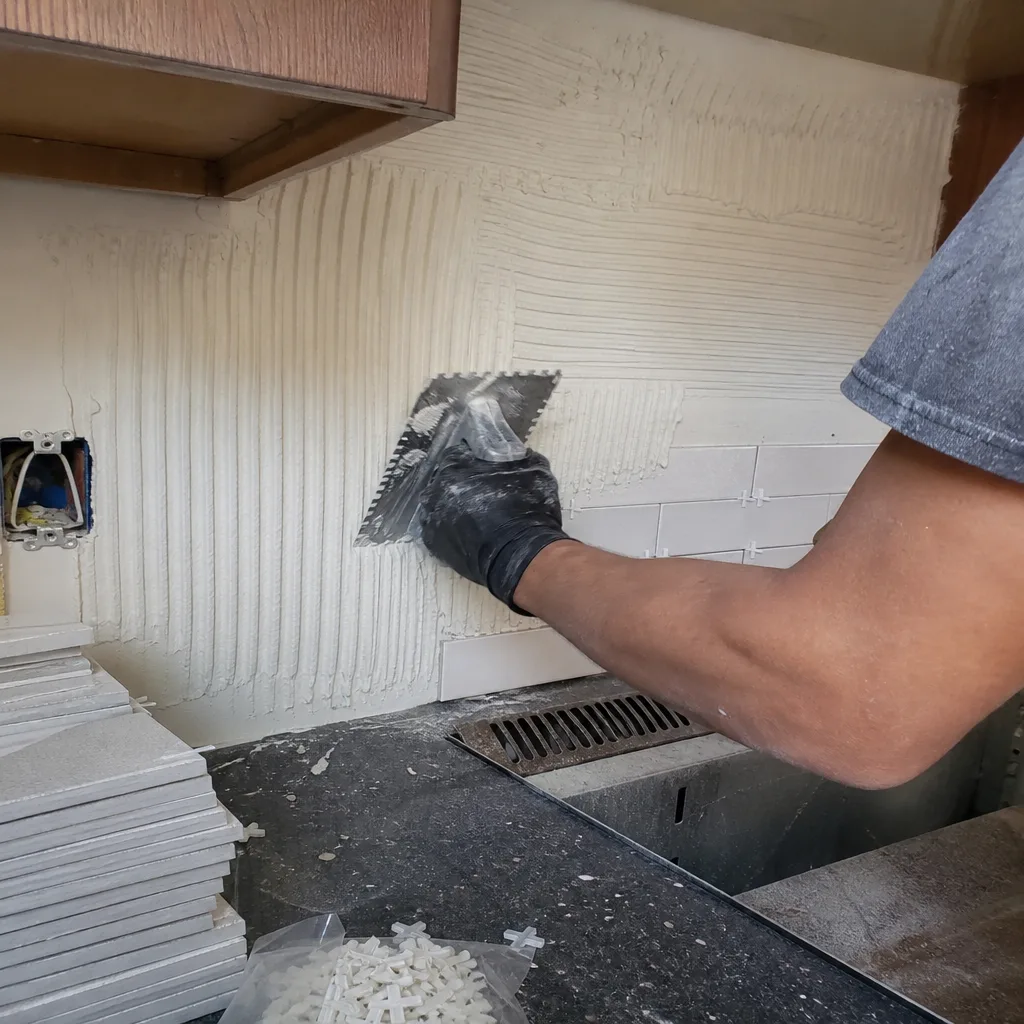
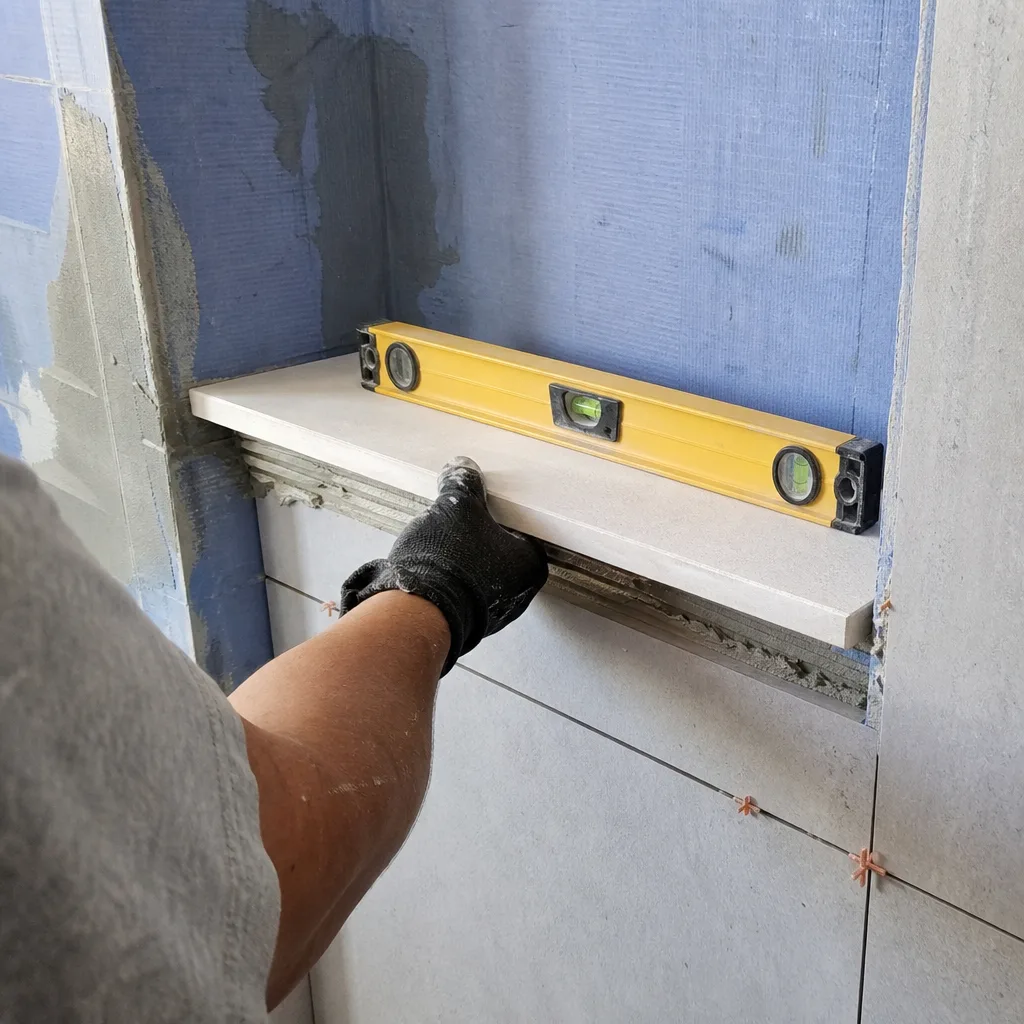
Thinset is mixed to the correct consistency for the tile type. Large-format tiles require a different thinset application (back-buttering in addition to the wall application) than small mosaic tiles. The installer works in sections, keeping joints consistent with spacers and checking level constantly on horizontal runs. Outlet and switch cutouts are made with a tile saw or angle grinder fitted with a diamond blade, not knocked out with a hammer.
Grouting and Finishing
Thinset needs a minimum cure time – typically 24 hours – before grouting. Grouting is applied with a rubber float, packed into the joints, and then the excess is wiped in passes with a damp sponge. The haze that remains after grouting is buffed off once the grout has begun to firm but before it fully cures. Caulk (not grout) goes at the transition between the backsplash and the countertop, and at any inside corners – because grout is rigid and cracks at movement joints, while caulk is flexible. Any quote or installer that uses grout at those transitions is setting up a future problem.
If the tile is natural stone, sealer goes on last. The installer documents the final result with another photo record. You know exactly what was done and what it looks like the day the crew left.
Materials: What We Use and Why
Rowan sources tile through vetted suppliers with consistent quality control. For standard ceramic and porcelain subway tile, Daltile and MSI are the workhorses – widely available in Chula Vista through local distribution, well-documented for dimensional consistency, and backed by manufacturer warranties that mean something. For glass tile, Bedrosians is a common sourcing point for South Bay projects. For natural stone, the specific quarry and finish matter more than the brand – we specify these on the written quote by material type, finish, and origin region.
Thinset selection is matched to the tile. Porcelain tile requires a polymer-modified thinset. Glass tile often requires a white thinset to avoid color bleed-through on translucent materials. Large-format tile requires a medium-bed mortar to account for slight warpage in large pieces. These aren’t premium add-ons – they’re the correct materials for the application, and using the wrong setting material is one of the most common reasons backsplash tile fails prematurely.
Grout selection follows the joint width and the use environment. Unsanded grout for joints under 1/8 inch. Sanded grout for 1/8 inch and wider. Epoxy grout in high-moisture environments or where staining resistance is critical – it costs more but doesn’t require sealing and resists the kind of grout discoloration that makes a kitchen backsplash look dated after 5 years.
FAQs: Backsplash Installation Cost in Chula Vista
How much does backsplash installation cost in Chula Vista?
Backsplash installation in Chula Vista costs $800-$2,500 for most residential projects, with the typical kitchen backsplash (20-40 square feet) landing between $1,100 and $1,700. The range is driven primarily by tile material choice and whether substrate repairs are needed after demo. Call (619) 536-0571 for a written, flat-price quote – estimates are free and the number you get is the number you pay.
How long does backsplash installation take?
A standard kitchen backsplash in Chula Vista takes 1-2 days of active work, with a 24-hour cure window between tile-setting and grouting. A small bathroom vanity backsplash (8-15 sq ft) can be completed in a single day including grouting if the substrate is in good condition. Projects requiring demo, substrate repair, or large-format tile setting typically run 2-3 days total. Your written scope will include a projected timeline before any work starts.
Is it cheaper to repair or replace a backsplash?
Repairing a backsplash – replacing a few broken or chipped tiles – costs $200-$600 for a small section, assuming matching tile is available. If the existing tile is discontinued or the grout is failing across a large area, replacement is almost always the better financial decision: a full replacement at $800-$2,500 gives you a new substrate assessment, new grout throughout, and a fresh warranty rather than a patchwork repair that remains structurally compromised. We’ll tell you which applies to your project after we see it – not before.
Do I need a permit for backsplash installation in Chula Vista?
No permit is required for a standard backsplash tile installation in Chula Vista, CA. The work is cosmetic and doesn’t involve structural, electrical, or plumbing modifications. If a backsplash project reveals underlying plumbing issues or requires moving an electrical outlet, those specific elements may trigger permit requirements – and we flag those on the written scope before any work proceeds. Under the Haven Standard, no change order proceeds without your signature, so you’re never surprised by permit costs mid-project.
Can Rowan match existing tile for a backsplash repair in Chula Vista?
Sometimes, and we’ll tell you honestly before the project starts. Tile matching depends on whether the original tile is still in production and whether the batch color variation is acceptable. For discontinued tile, we source through liquidation suppliers and tile warehouses in San Diego County – we’ve matched tiles for homes in Chula Vista’s older Rancho Del Rey and Montgomery neighborhoods where original materials are 20-plus years old. When a match isn’t achievable, we document that finding with photos and give you the options in writing before any work begins.
What’s the difference between grout and caulk, and why does it matter for my backsplash?
Grout is rigid and is used to fill joints between tiles on a flat surface. Caulk is flexible and is used at transitions – where the backsplash meets the countertop, and at inside corners where two walls meet. Using grout at those transitions is a common installation shortcut that causes visible cracking within 1-3 years as the house settles and materials expand and contract with Chula Vista’s coastal temperature swings. On every Rowan backsplash installation, caulk goes at every transition joint – it’s in the written scope, not a verbal promise.
Key Takeaways
- Backsplash installation in Chula Vista costs $800-$2,500, with most kitchens landing in the $1,100-$1,700 range.
- Tile material is the biggest cost variable – ceramic runs $2-$5/sq ft, Zellige and artisan tile runs $14-$22/sq ft.
- Pattern complexity (herringbone, diagonal) adds $6-$14/sq ft in labor over a straight stack layout.
- Substrate condition in Chula Vista homes – especially pre-2005 construction – often requires backer board or waterproofing membrane, adding $200-$500 but extending tile life significantly.
- A written, flat-price quote with a defined scope is the only way to know what you’ll actually pay. Rowan delivers that before any work starts, every time.
- The 365-Day Done Right Promise backs every Rowan installation – if it’s not right, Grant Rowan’s team makes it right.
- No change proceeds without a signed change order, which is the practice that has kept Rowan projects within a few percent of the agreed price across 4,000-plus jobs since 2007.
Ready to Get a Written Price for Your Chula Vista Backsplash?
Grant Rowan and the Rowan Construction Group team have been delivering written prices before work starts since 2007 – across 4,000-plus projects, including hundreds of kitchen and bathroom upgrades in Chula Vista, Eastlake, Otay Ranch, and the surrounding South Bay communities. A free estimate means a flat price with a written scope lands in your hands before a single tile is ordered.
If you’ve already got a quote from another contractor, bring it. The Free Second Opinion is a standing offer – we’ll review it line by line at no charge and tell you what’s fair, what’s missing, and what questions to ask. No pressure, no sales process.
Call (619) 536-0571 to schedule your free backsplash estimate in Chula Vista. A live person answers. The written price follows. Work starts only when you’ve signed off on both the scope and the number.
Written by Grant Rowan, Owner at Rowan Construction Group, serving Chula Vista since 2007. Pricing reflects the Chula Vista market as of 2026. Rowan Construction Group Chula Vista offers free estimates – call (619) 536-0571.
What Our Customers Say
"Fence and retaining wall along a sloped boundary. They photographed the footing depth at each post, which mattered when the county inspector came."
- Iona F."Final invoice was within two percent of the contract. Every change was priced and signed before anyone picked up a tool."
- Malcolm T."Driveway replaced properly with a base that will actually last. They explained why the cheaper quote was cheaper."
- Reggie O.